
You have probably seen the term “end-to-end encryption” when using messaging apps, cloud storage services, or file-sharing platforms. Many companies advertise it as a major security feature, but for most people, the technology behind it can seem confusing.
The good news is that end-to-end encryption is easier to understand than it sounds. At its core, it is a way of protecting data so that only the intended sender and recipient can access it.
This guide explains end-to-end encryption in simple terms, how it works, why it matters, and how it helps keep your files and communications private.
What Is End-to-End Encryption?
End-to-end encryption, often shortened to E2EE, is a security method that prevents anyone except the intended recipient from reading data.
Imagine placing a document inside a locked box before sending it.
Only the person who has the correct key can unlock and read the contents.
Even the company transporting the box cannot open it because they do not have the key.
End-to-end encryption works in a similar way for digital information.
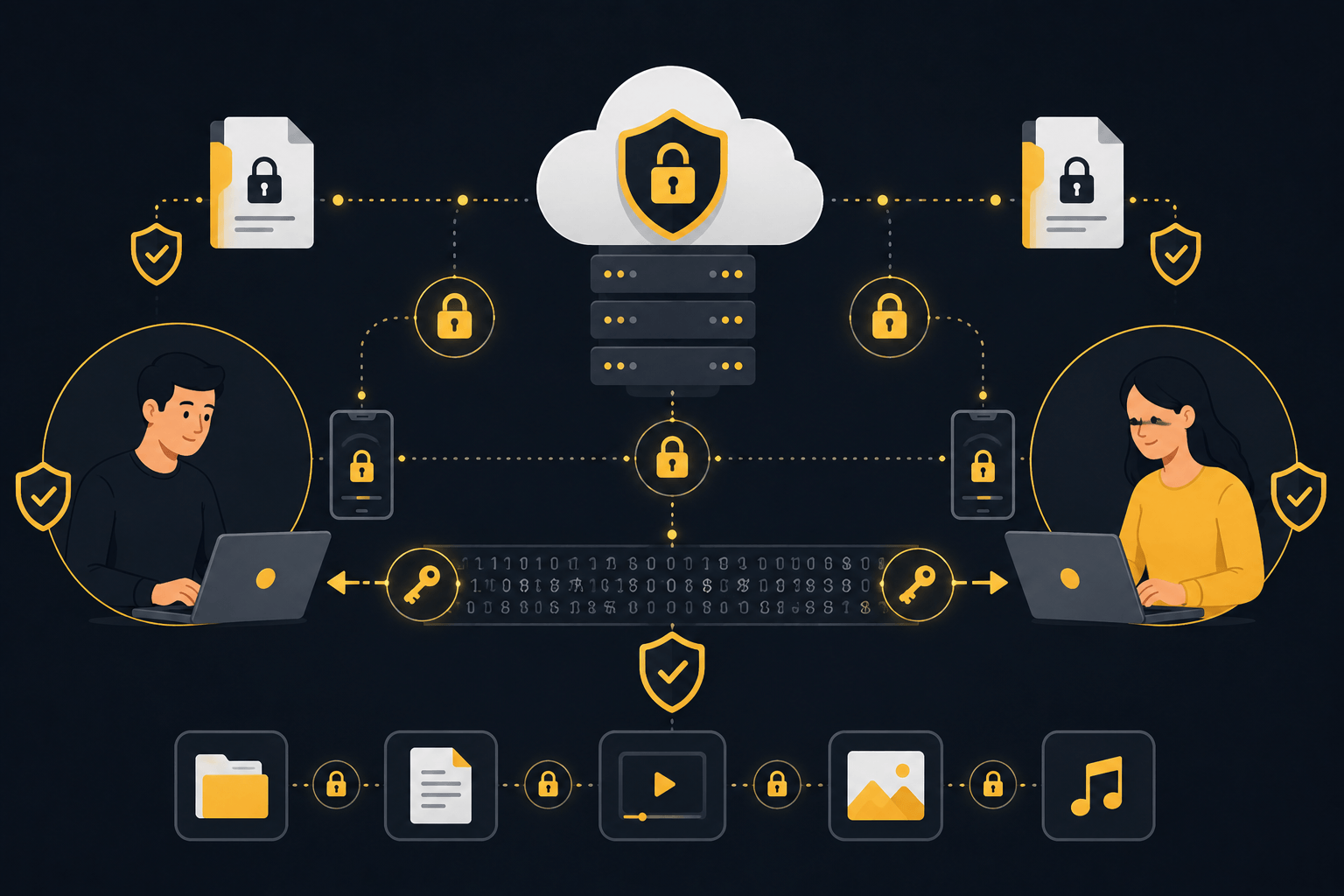
Before a message or file leaves your device, it is encrypted into unreadable data. It remains encrypted while traveling across the internet and while passing through servers. Only the recipient’s device can decrypt and read the information.
How End-to-End Encryption Works
The process happens automatically in modern applications.
Here’s a simplified version:
- You create a message or file.
- Your device encrypts the data.
- The encrypted data travels through the internet.
- Servers transport the encrypted information.
- The recipient’s device decrypts the data.
- The original content becomes readable.
During transmission, the information looks like random characters rather than meaningful text or files.
For example:
Original message:
Hello, how are you?
Encrypted version:
X7#A9!vQ2@Lm$1
The encrypted data is useless without the proper decryption key.
This is what makes end-to-end encryption so effective.
Why Is End-to-End Encryption Important?
Every day, sensitive information moves across the internet.
Examples include:
- Personal messages
- Business documents
- Financial information
- Photos and videos
- Medical records
- Login credentials
Without encryption, anyone who intercepts the data could potentially read it.
End-to-end encryption helps prevent:
- Unauthorized access
- Data theft
- Network eavesdropping
- Information leaks
- Certain types of cyberattacks
It provides a strong layer of privacy regardless of where the data travels.
End-to-End Encryption vs Standard Encryption
Many people assume all encryption works the same way, but there is an important difference.
Standard Encryption
With standard encryption, data may be encrypted during transfer and storage, but the service provider often has access to the decryption keys.
This means the provider could technically access the information if necessary.
End-to-End Encryption
With end-to-end encryption, only the sender and recipient possess the keys needed to decrypt the data.
The service provider cannot view the content.
This is why end-to-end encryption is often considered one of the strongest privacy protections available.
A Simple Real-World Example
Imagine sending a letter through the postal system.
Without End-to-End Encryption
The letter travels in a transparent envelope.
Anyone handling it can read the contents.
With End-to-End Encryption
The letter is placed inside a locked safe.
Only the recipient has the combination needed to open it.
The delivery company can transport the safe, but it cannot access the contents.
This analogy captures the basic idea behind end-to-end encryption.
Where Is End-to-End Encryption Used?
End-to-end encryption is widely used across modern digital services.
Common examples include:
- Messaging applications
- Video calling services
- Email security tools
- File-sharing platforms
- Cloud storage services
- Password managers
Many privacy-focused platforms use end-to-end encryption as a core feature because it limits access to user data.
When evaluating a service, checking whether it offers true end-to-end encryption can be an important security consideration.
What End-to-End Encryption Does Not Protect Against
While end-to-end encryption is powerful, it is not a complete security solution.
It does not protect against:
Weak Passwords
If someone gains access to your account through a weak password, encryption may not help.
Malware on Your Device
If malicious software is installed on your computer or phone, it may capture information before encryption occurs.
Shared Access
If you intentionally share a file or account with another person, encryption cannot prevent that person from accessing the data.
Social Engineering
Scams that trick users into revealing information can bypass technical security measures.
Good security requires more than encryption alone.
Common Myths About End-to-End Encryption
Myth 1: Encryption Is Only for Experts
Modern encryption works automatically. Most users benefit from it without needing technical knowledge.
Myth 2: Encryption Makes Systems Slow
Modern devices handle encryption efficiently, often without noticeable performance differences.
Myth 3: Only Businesses Need Encryption
Personal information is valuable too. Photos, messages, financial records, and private documents all benefit from stronger protection.
Myth 4: End-to-End Encryption Means Complete Anonymity
Encryption protects data contents, but it does not automatically hide every detail about who is communicating or when communication occurs.
Privacy and anonymity are related but different concepts.
How to Improve Security Beyond Encryption
Even when using end-to-end encrypted services, additional security practices are important.
Recommended steps include:
- Use strong passwords.
- Enable two-factor authentication.
- Keep devices updated.
- Avoid suspicious links.
- Secure your devices with screen locks.
- Back up important files safely.
Encryption is strongest when combined with good security habits.
Should You Care About End-to-End Encryption?
For most people, the answer is yes.
You do not need to be a cybersecurity expert or a large business to benefit from stronger privacy protections.
Whether you are storing personal files, sharing sensitive documents, or sending private messages, end-to-end encryption helps reduce the risk of unauthorized access.
The best part is that modern services often handle the technical complexity automatically, allowing users to enjoy stronger security without additional effort.
Conclusion
End-to-end encryption is one of the most effective ways to protect digital information. By encrypting data before it leaves your device and allowing only the intended recipient to decrypt it, the technology creates a secure communication channel that even service providers cannot easily access.
While no security solution is perfect, end-to-end encryption significantly improves privacy and helps protect messages, files, and sensitive information from unauthorized access. Understanding this technology makes it easier to choose secure services and take control of your digital privacy in an increasingly connected world.